Middle Powers in Global Governance by Emel Parlar Dal
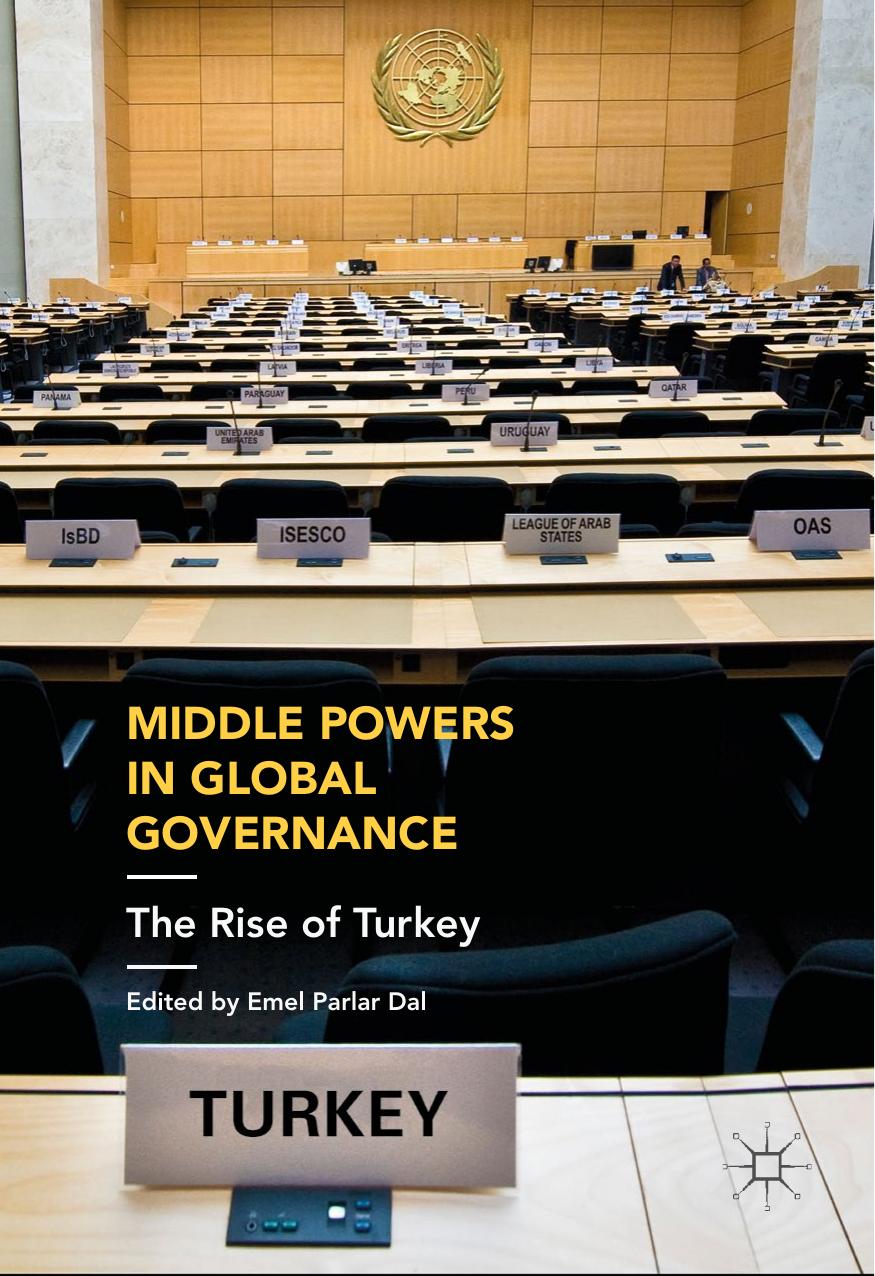
Author:Emel Parlar Dal
Language: eng
Format: epub, pdf
Publisher: Springer International Publishing, Cham
Turkey and MIKTA at the UN: Toward a Common Middle Power Role?
The role of multilateralism and strong sense of internationalism in Turkish foreign policymaking is hardly new. Since its establishment, the identity of the new Turkish Republic was defined by Mustafa Kemal as a âmodern state which aims to coexist peacefully with international society of statesâ (Sander 1998: 141). Beginning with the early Republican era, Turkish rulers have chosen to act with multilateral institutions such as the League of Nations, the UN, the European Union (EU), and North Atlantic Treaty Organization (NATO). Turkey was one of the founding members of the UN and held non-permanent seats on the Security Council (UNSC) during the 1951â1952, 1954â1955, and 1961 (shared with Poland) terms. In its first term on the Council (1951â1952), Turkey served as the Middle Eastern Council member, occupied the Eastern European seat twice (1954â1955 and 1961), and has since run for the Western European and Others Group (WEOG) seat (Sever and Gök 2016). Interestingly, Turkey is the only country to have been elected to the Council under all the groupings (Loraine and Daws 2014: 138), illustrating its in-between identity. Scholars and politicians have variously identified Turkey as a âcuspâ state (Herzog and Robins 2014), âliminal stateâ (Yanık 2011: 59â114), âbridgeâ (Yanık 2009: 531â549), âworld stateâ (Cem 2002), and âcenter stateâ. Among these, middle power role has not been pronounced.
However, Ankaraâs behavioral denominators point to it occupying a middle power role since the early Republican period. In a study of Turkeyâs middle power behavior back to the diplomatic activism of the 1930s, Barlas (2005) argues that Turkey made every effort to use its diplomatic capacity successfully in the Balkans and Mediterranean by pursuing multilateral solutions to international problems and constructing coalitions with like-minded states in the 1930s (Barlas 2005: 464). During the Cold War era, despite some exceptional periods in the 1960s and 1970s when Turkey intervened militarily in Cyprus, Turkey has generally pursued a peaceful multilateral diplomacy by remaining explicitly attached to the norms and decisions of the UN (Parlar Dal 2013: 715). Despite intense criticism toward the UN, the 1990s were also marked by one of Turkeyâs most active multilateral diplomacies in the UN since its establishment. Ankara strived to take a role in the restructuring of the postâCold War regional and global order through multilateral platforms, especially in the UN, as it tried to play an active role in the solution of the Yugoslavian crises (OÄuz Gök: 87).
Download
Middle Powers in Global Governance by Emel Parlar Dal.pdf
This site does not store any files on its server. We only index and link to content provided by other sites. Please contact the content providers to delete copyright contents if any and email us, we'll remove relevant links or contents immediately.
| Anthropology | Archaeology |
| Philosophy | Politics & Government |
| Social Sciences | Sociology |
| Women's Studies |
The Secret History by Donna Tartt(19016)
The Social Justice Warrior Handbook by Lisa De Pasquale(12179)
Thirteen Reasons Why by Jay Asher(8879)
This Is How You Lose Her by Junot Diaz(6867)
Weapons of Math Destruction by Cathy O'Neil(6257)
Zero to One by Peter Thiel(5778)
Beartown by Fredrik Backman(5726)
The Myth of the Strong Leader by Archie Brown(5489)
The Fire Next Time by James Baldwin(5421)
How Democracies Die by Steven Levitsky & Daniel Ziblatt(5207)
Promise Me, Dad by Joe Biden(5138)
Stone's Rules by Roger Stone(5073)
A Higher Loyalty: Truth, Lies, and Leadership by James Comey(4944)
100 Deadly Skills by Clint Emerson(4908)
Rise and Kill First by Ronen Bergman(4766)
Secrecy World by Jake Bernstein(4735)
The David Icke Guide to the Global Conspiracy (and how to end it) by David Icke(4694)
The Farm by Tom Rob Smith(4498)
The Doomsday Machine by Daniel Ellsberg(4477)
